Platform engineer with experience building cloud infrastructure.
Platform engineer building reliable cloud infrastructure and developer tooling for growing engineering teams.
Most applications are read by software before a person sees them. Waypoint shows how your resume lines up with each job, tailors it in your own words, and tracks every application from saved to offer.
Tracking is free forever. AI runs on credits.
Works on LinkedIn, Indeed, Glassdoor and company career pages, and saves from any other page with a right-click.

Two hundred and forty-four. That's how many applications the average job gets now.
Ninety-seven percent of Fortune 500 companies use an ATS. It collects every application, scans and analyzes each resume, and lets recruiters filter and rank them.
And eighty-eight percent of employers say qualified people get filtered out for not matching the job description exactly.
You can't control who reads it. You can control what you send. Here's how Waypoint helps.
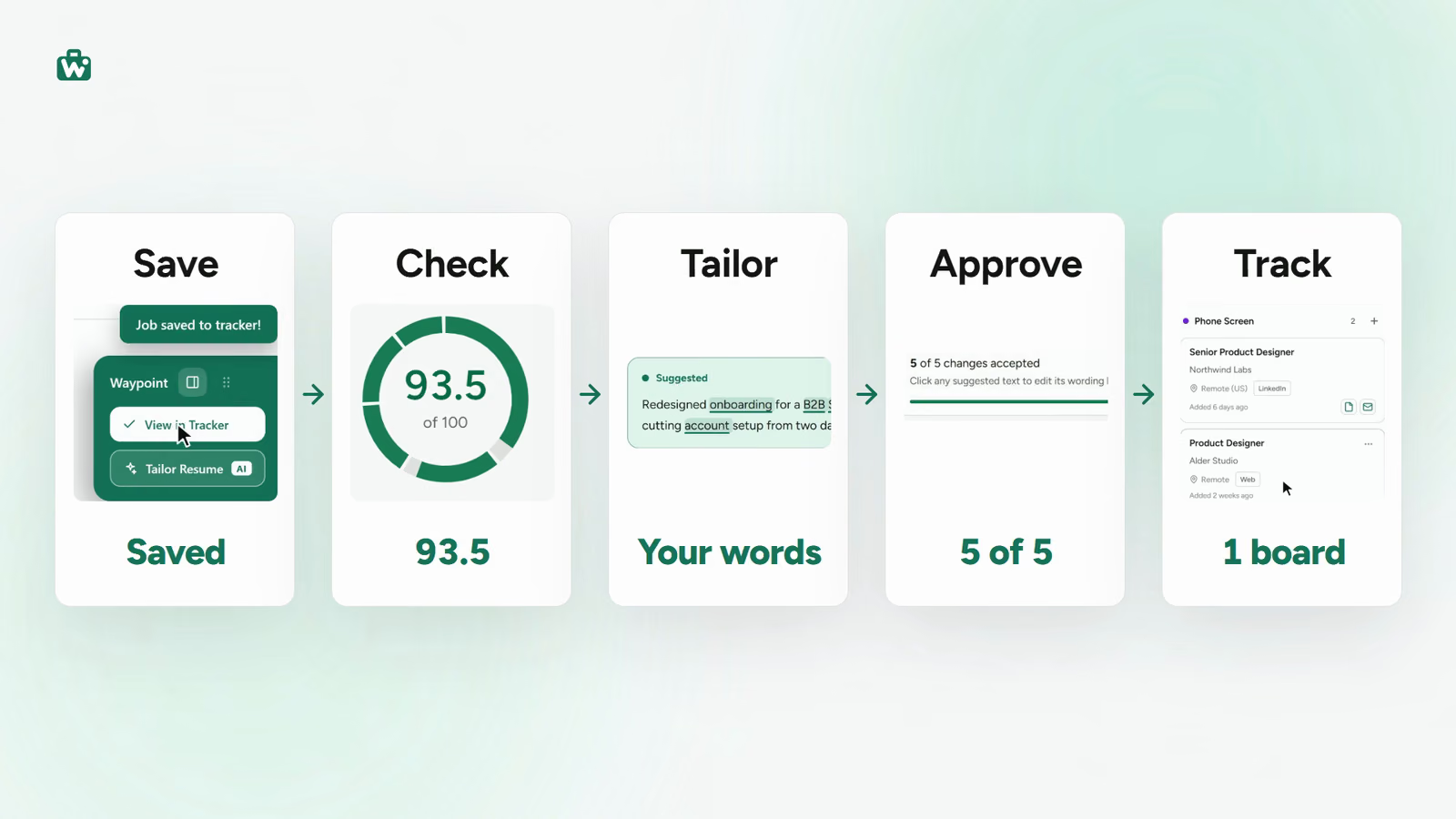
Save the job from LinkedIn, Indeed or any careers page, in one click.
See how your resume lines up with that job: five checks, and what to fix first.
Tailor it to the job description, starting from your own resume. Your work, your numbers, the posting's words. AI phrasing is swapped for plain words.
And nothing's saved until you approve it.
Then track every application on one board, stage by stage.
Every step to your next job, marked.
Waypoint, on Chrome and on the web.
Many employers, especially larger ones, run applications through an applicant tracking system (ATS). It reads your resume into fields, compares it with the job posting, and helps recruiters sort and search candidates.
Save a job, check your resume against it, tailor it, approve every change, and track where it goes.
On LinkedIn, Indeed, Glassdoor and company career pages, hover the Waypoint tab and press Save. Anywhere else, right-click and choose “Save this job to Waypoint”.
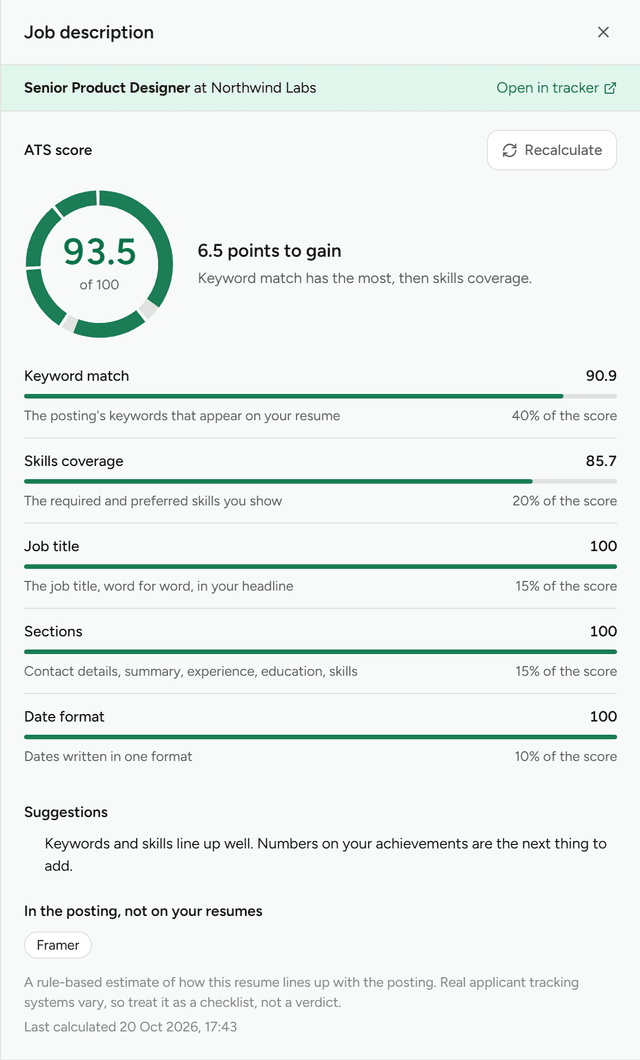
A score out of 100 for how your resume lines up with the job, with the breakdown behind it. It’s rule-based, uses no AI and never costs a credit, so treat it as a checklist, not a verdict.
| Keyword match | 40% |
|---|---|
| Skills coverage | 20% |
| Job title | 15% |
| Sections | 15% |
| Date format | 10% |

Waypoint rewords the experience you already have toward the posting. It doesn’t add jobs, metrics or history you don’t have, and stock AI phrasing is swapped for plain words.

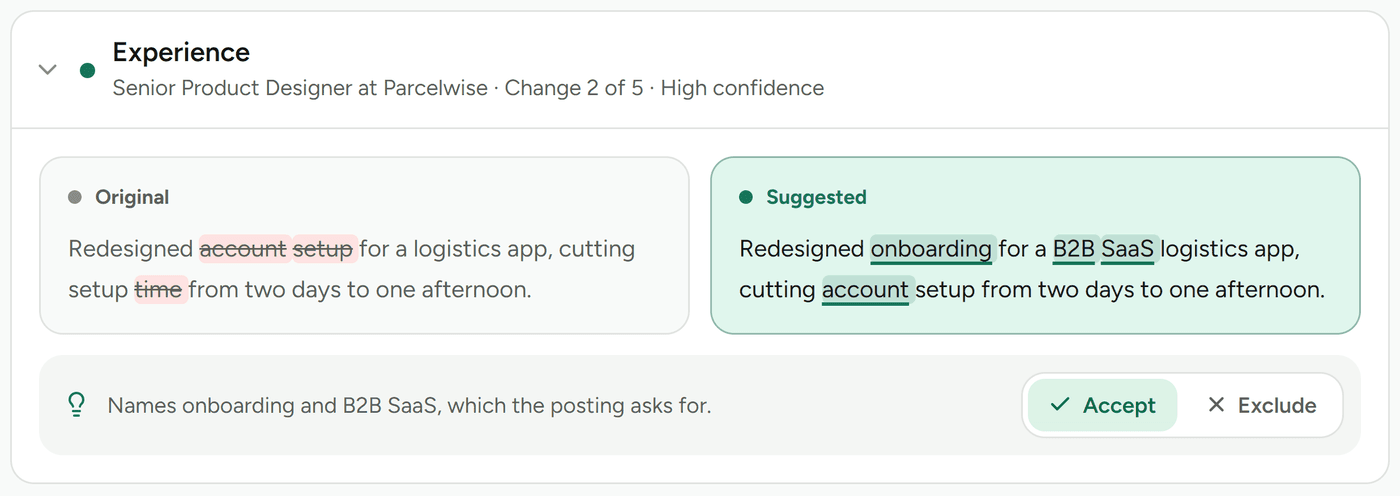
Every change sits next to your original. Keep it, edit it, or strike it out. Nothing is saved until you approve it. Try it on this sample.
Senior Platform Engineer
Platform engineer with experience building cloud infrastructure.
Platform engineer building reliable cloud infrastructure and developer tooling for growing engineering teams.
Worked on deployment pipelines and monitoring for internal services.
Built deployment pipelines and observability for internal services, helping engineers ship with confidence.
Supported backend services and helped resolve production issues.
Led a company-wide reliability program across every engineering team.
Every application on one board, stage by stage. Start from one of ten industry pipelines, then rename, reorder or hide the stages.
A draft for any saved job, based on the posting and your resume, that you edit before you send.
A short note for LinkedIn or email, addressed to a saved contact. Waypoint never sends it.
Why you fit, likely questions and talking points for that specific role.
Four resume templates (three on Pro), a live preview, and PDF export.
Every plan gets the whole tracker: your stages, the dashboard and the export. Paid plans buy credits and three specific features.
Nothing is locked behind Ultimate. It is Pro with ten times the credits, for people tailoring a resume most days.
Go UltimateOne credit is one AI action: a tailoring pass, a cover letter, an outreach note, or an interview prep sheet. Paid credits reset monthly and do not roll over. Cancel from the extension whenever.
No. Waypoint does not submit applications, send messages, or fill forms on your behalf. It has no such feature and is not getting one.
Only when you press a button, on the job you have open. Nothing is analyzed in the background, and nothing is sent while you browse.
On your resume, change by change — that is the whole point of the review screen. Cover letters, outreach and prep arrive as drafts you edit in a normal text box.
Tailoring rewords the bullets you already have rather than writing new ones, then swaps out the stock phrasing recruiters notice (leveraged, spearheaded, cutting-edge) for plain words. A word the posting uses itself is left alone. You still read and approve every change, so the last pass is yours.
It is told not to, and it is checked: any skill, certification or employer in the tailored version that is not on your resume is taken out before you see it. Anything that gets past that check is still a suggestion you can strike out.
LinkedIn, Indeed and Glassdoor have purpose-built extraction. Anywhere else — company career pages included — you can still save the job from the toolbar popup or a right-click, and fill in what is missing.
You sign in with Google, and your applications sync through Waypoint’s own servers so they follow you across devices. When you trigger an AI action, that resume and job description go to OpenAI for that request only. Per OpenAI’s API policy, data sent through the API is not used to train their models.
The AI buttons stop and everything else keeps working. Tracking, stages, dashboard and export are free on every plan, including the free one.
Save from the popup or the side panel beside a posting, pick up on your new tab, and open the same board in the web app.
Tracking is free forever. AI runs on credits.